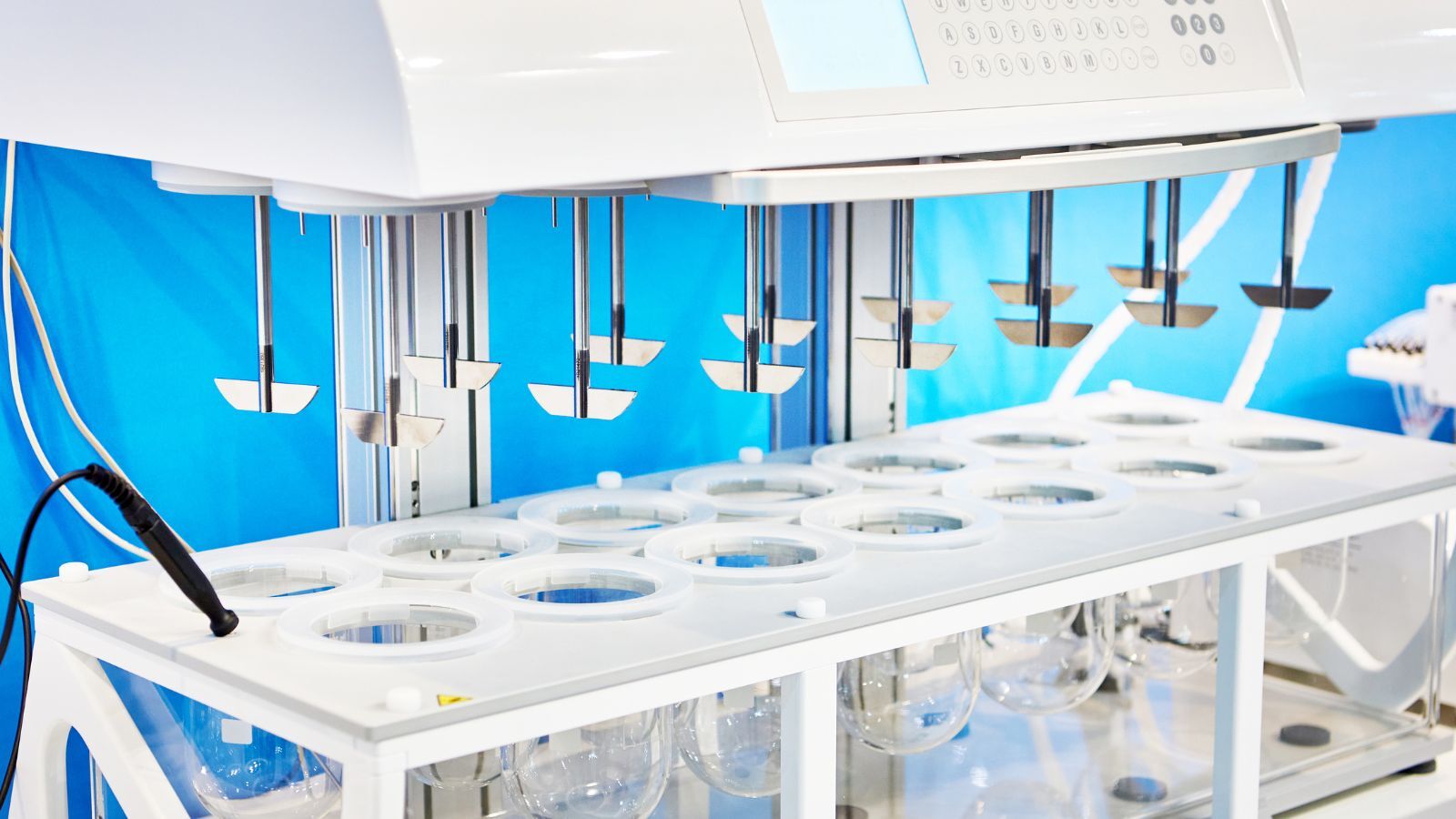
Designing a dissolution test is rarely a purely theoretical exercise. In practice, teams must balance scientific relevance, regulatory expectations, and operational robustness, often under tight development timelines and with limited material. A dissolution method that looks sound on paper can quickly become problematic if it fails to discriminate, lacks robustness, or proves difficult to transfer between laboratories.
Meaningful dissolution testing goes beyond meeting pharmacopeial requirements. It plays a critical role in:
- understanding formulation behavior,
- controlling manufacturing variability,
- and supporting confident regulatory decision-making across the product lifecycle.
Building on these practical realities, this article explores how dissolution tests are designed, executed, and interpreted in day-to-day pharmaceutical development, quality control, and regulatory contexts.
It also complements our earlier blog, “ The Evolution and Future of Dissolution Testing in Pharmaceutical Development, ” which examined the historical and technological drivers that shaped modern dissolution approaches.

Need reliable lab testing and validation?
Achieving Meaningful Dissolution Testing
At its core, dissolution testing aims to establish a method that can reliably differentiate between factors influencing drug release and, ultimately, in vivo performance.
A meaningful dissolution method must be sufficiently sensitive to detect variations in critical manufacturing and formulation parameters, such as drug substance particle size, compression force, or tablet hardness, while clearly distinguishing between products manufactured under optimal conditions and those with clinically or technically relevant deviations.
Equally important, the method must be robust, reproducible, and suitable for routine use. It should be transferable between laboratories without introducing variability that could compromise data integrity, regulatory confidence, or batch release decisions.
Practical Foundations of Dissolution Testing
Dissolution Medium and Test Conditions
The dissolution process begins with selecting an appropriate liquid medium, which is introduced into the vessels of the dissolution apparatus. Depending on the product and its intended use, this medium may range from degassed deionized water to buffered solutions with defined pH values or surfactant-containing formulations.
In many cases, the dissolution medium is water- or water-based, with a pH typically between 5 and 7 and a controlled temperature of 37 °C, in line with pharmacopeial requirements and physiological relevance.
Proper degassing of the medium - often achieved through sonication or other validated techniques - is essential, as dissolved gases can interfere with hydrodynamics and affect dissolution results.
Once the medium has reached the specified temperature, the dosage form is introduced into the vessel and the dissolution apparatus is activated under controlled conditions.
Sampling and Analytical Evaluation
Samples collected during dissolution testing are commonly analyzed using High-Performance Liquid Chromatography (HPLC) or Ultraviolet–Visible (UV-Vis) spectroscopy. Results are assessed against predefined release specifications, both at the individual unit level and as an overall average.
A central parameter in dissolution testing is Q, which represents the specified percentage of active ingredient that must be dissolved within a defined timeframe, as described in the product monograph.
If Stage 1 (S1) testing does not meet the Q requirement, additional units are tested in Stage 2 (S2). Failure at S2 triggers Stage 3 (S3) testing. Persistent failure to meet Q at S3 typically leads to an Out-of-Specification (OOS) investigation to identify root causes and assess product impact.
The Role of Dissolution Testing in Pharmaceutical Development
1. Drug Formulation and Optimization
Dissolution testing plays a central role in formulation development by enabling scientists to evaluate and optimize drug release characteristics. Through systematic assessment of excipients, particle size distribution, and manufacturing processes, dissolution data support the design of formulations that deliver consistent therapeutic performance aligned with clinical requirements.
2. Quality Control and Regulatory Compliance
As a mandatory quality control test for solid dosage forms, dissolution testing ensures batch-to-batch consistency and compliance with global regulatory standards. It is frequently used as a release test and serves as an early indicator of formulation or manufacturing variability before products reach the market.
Key Quality Control Considerations
- Apparatus calibration and qualification: Regular verification of rotation speed, temperature control, and vessel alignment is essential for reproducible results.
- Method validation: Dissolution methods must demonstrate accuracy, precision, specificity, and robustness in accordance with regulatory guidelines.
- Dissolution profile comparisons: Statistical tools such as similarity factor ( f₂) analysis are used to compare profiles across batches or formulation changes.
- Environmental controls: Tight control of temperature, humidity, and medium pH is required to minimize analytical variability.
- Sample handling and storage: Proper preparation and handling of samples are critical to ensure reliable and interpretable results.
3. Biowaivers and Generic Drug Approval
For generic drug development, dissolution testing is a key tool for demonstrating bioequivalence with reference products. Within the Biopharmaceutics Classification System (BCS) framework, biowaivers may reduce or eliminate the need for in vivo studies when dissolution criteria are met.
However, dissolution testing alone cannot fully capture the complexity of human physiology and in vivo drug behavior. While biorelevant media can improve predictive value, the extent to which a dissolution method reflects in vivo performance often remains uncertain without supporting clinical data.
4. Stability and Post-Marketing Surveillance
Dissolution testing is also integral to stability studies and lifecycle management. Changes in dissolution behavior over time - due to formulation adjustments, storage conditions, or packaging interactions - can directly impact product performance.
Ongoing dissolution monitoring supports post-approval commitments and helps ensure sustained product quality throughout the lifecycle.
Conclusion
When designed and applied thoughtfully, dissolution testing becomes far more than a routine analytical requirement. It provides critical insight into
- formulation behavior,
- manufacturing variability,
- and product performance,
supporting informed decisions throughout development, registration, and lifecycle management.
By approaching dissolution testing as part of a broader Quality by Design strategy, teams can reduce development risk, strengthen regulatory confidence, and avoid late-stage rework. This requires methods that are scientifically justified, sufficiently discriminatory, robust for routine use, and transferable across laboratories and manufacturing sites.
QbD Group supports pharmaceutical and biotech organizations in designing and implementing dissolution strategies that meet these objectives. Combining analytical expertise, regulatory insight, and practical development experience, our teams help ensure dissolution testing supports sound decision-making.
This includes support from early formulation development and method validation through to regulatory submissions, troubleshooting, and lifecycle management.
If you are looking to strengthen your dissolution approach or address specific method development or transfer challenges, QbD Group’s experts are ready to support you with tailored scientific and regulatory guidance.
Don’t hesitate to get in touch.
Need reliable lab testing and validation?
About the Author

MP, QP · Division Head Lab Services
Yves leads the Lab Services division at QbD Group, bringing deep expertise in GMP laboratory operations, analytical method validation, and quality control for pharmaceutical manufacturing.