EU GMP Annex 1 has accelerated a shift that many manufacturers were already moving toward. Regulators increasingly expect contamination control to be engineered into the facility and process design, not managed through procedural workarounds.
In practice, that means cleanroom performance, airflow protection, and barrier technologies are now assessed as part of a single contaminationcontrol strategy, rather than as independent compliance topics.
This article explains how Annex 1 expectations reshape cleanroom and barrier design decisions, and what manufacturers need to demonstrate during inspection.
Why cleanroom and barrier decisions now drive inspection outcomes
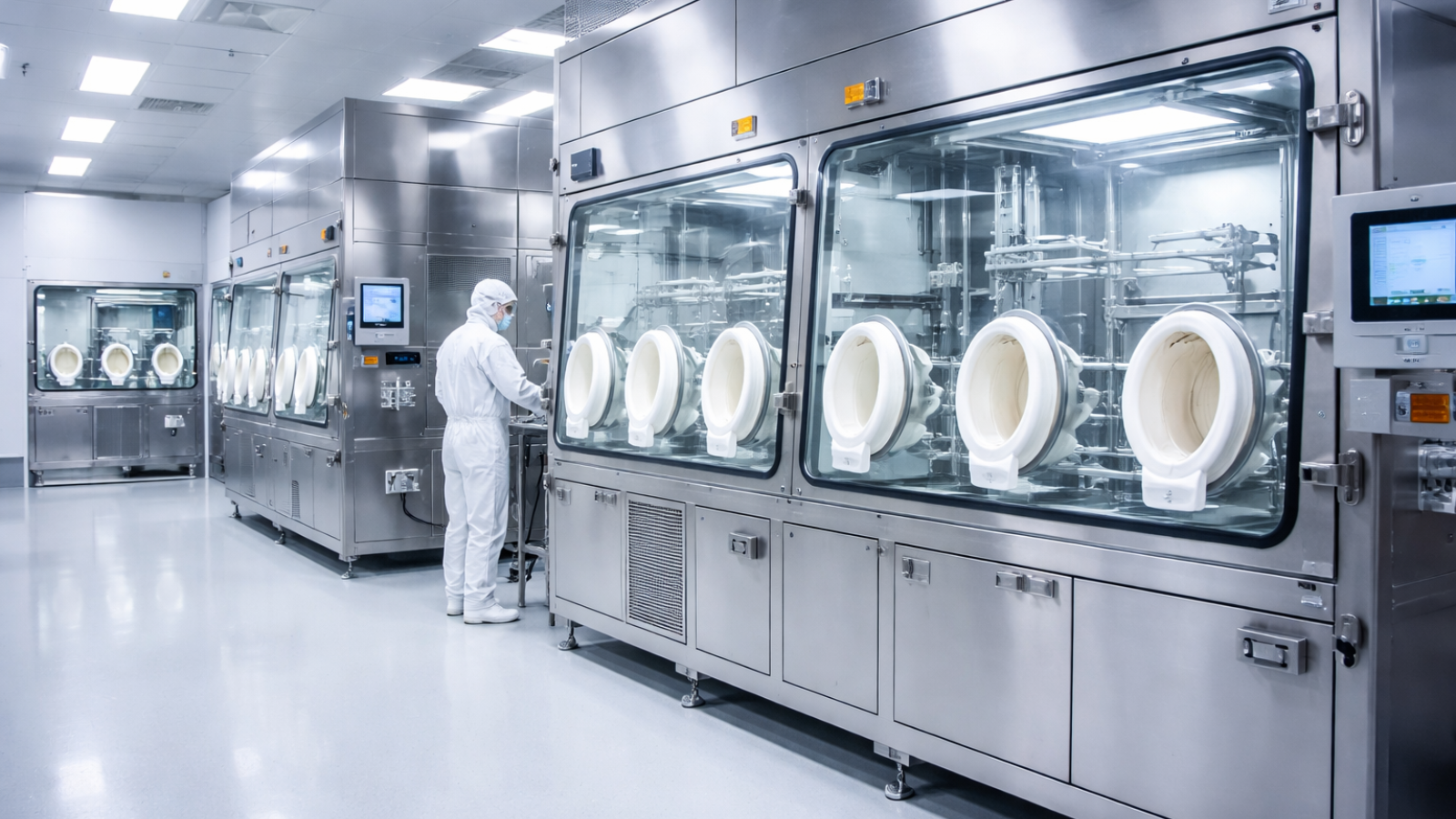
Annex 1 makes clear that sterile operations must be performed in an environment appropriate to the activity, using defined cleanroom grades and controls. It also explicitly positions Restricted Access Barrier Systems and isolators as beneficial for minimizing contamination linked to direct human intervention in the critical zone, and it expects alternative approaches to be justified within the CCS.
This has two direct implications for manufacturers who are still operating conventional Grade A and B cleanrooms without robust separation principles.
-
First, inspectors are less concerned with whether a room complies with particle limits under static conditions and more focused on whether the process remains protected during real operations.
-
Second, regulators increasingly focus on the points where the cleanroom concept breaks down, such as open manipulations, frequent interventions, weak separation, and poorly controlled material and personnel flows.
Barrier technologies are not a standalone solution, but they significantly reduce one of the most persistent sources of aseptic risk: human intervention.
FDA has made a similar point for years, highlighting that isolator systems separate the aseptic process from the surrounding cleanroom and minimize exposure to personnel, provided they are well-designed and adequately maintained, monitored, and controlled.
What Annex 1 Really Expects from Facility and Barrier Improvements
A cleanroom or barrier upgrade is often misunderstood as a single capital project. In reality, Annex 1 pushes manufacturers to treat facility and barrier decisions as part of an integrated risk control approach. That includes:
- the background environment,
- the interface between critical and surrounding zones,
- decontamination approaches,
- glove management for barrier systems,
- and how the overall design limits the need for interventions.
In practical terms, upgrades typically fall into three categories:
1. Separation and flow control
This includes zoning design, pressure cascades, airlocks, pass-throughs, and layouts that prevent cross traffic and contamination pathways. These elements are often where legacy facilities struggle, especially when product changes, higher throughput, or new formats increase operational complexity.
2. Barrier strategy
Choosing between open RABS, closed RABS, isolators, or more closed and automated solutions should be driven by the risk profile of the operation and the ability to control interventions. Annex 1 expects this logic to be visible in the CCS. If the process remains open, the justification must be credible and supported by risk assessment and operational controls.
3. Qualification evidence
Regulators increasingly look for proof that airflow protection and segregation principles work as intended in operation,not just in design documents.
Inspection Expectations and Supporting Documentation
One recurring theme across Annex 1 and long-standing FDA expectations is that sterile manufacturing control must be demonstrated, not assumed. For cleanrooms and barrier systems, that demonstration often comes down to three types of evidence:
1. Airflow protection evidence
Annex 1 expects airflow patterns to be visualized to demonstrate product protection and to show that air from lower-grade areas does not compromise critical zones under operating conditions. This is where airflow visualization studies, often called smoke studies, become more than a validation checkbox. They provide visual evidence of first air protection, turbulence risks, and the impact of interventions or equipment configuration on airflow.
2. Barrier integrity and interface evidence
For RABS and isolators, inspectors will look at how glove integrity is assured, how transfers are controlled, and how decontamination is validated. FDA guidance similarly emphasizes that isolator systems must be supported by adequate monitoring and control. This is particularly relevant when manufacturers rely on barriers but still perform high-intervention operations.
3. Background environment and classification logic
Annex 1 is explicit about cleanroom grades for sterile manufacture and expects the surrounding environment to be appropriate to the activity. Manufacturers often lose credibility when the background classification, operational practices, and intervention frequency do not align with the claimed control strategy.
Where Remediation Projects Commonly Get Delayed
In our experience, the most common delays and cost escalations do not come from deciding to implement barrier technology. They come from treating cleanroom upgrades, barrier selection, and qualification evidence as separate workstreams.
For example, airflow visualization is sometimes planned late, after equipment is installed and operating procedures are already fixed. When smoke studies reveal airflow disruption or contamination pathways, the remediation becomes expensive because the facility and line configuration are already locked.
Similarly, facility design changes are sometimes made without a clear link to CCS logic, which creates a documentation gap that regulators will challenge.
A Practical Approach to Planning Annex 1 Upgrades
A strong approach starts with defining the risk drivers of the operation and the intervention profile, then selecting the barrier and background strategy that best controls those risks. The CCS should capture this rationale, and the qualification plan should be built to demonstrate protection under real operating conditions.
This is also where an integrated support model adds value. Facility design and qualification activities must align with the barrier strategy. Airflow visualization must be planned as evidence, not as a late-stage test. Technology decisions should be anchored to contamination control logic rather than vendor preferences.
Conclusion
Annex 1 has raised the bar for how cleanroom design and barrier technologies are justified and demonstrated. Manufacturers that treat cleanroom classification, barrier selection, and qualification evidence as one coherent program are better positioned to avoid late remediation, inspection surprises, and credibility loss.
The most efficient path is not necessarily the most complex technology; it is the one that reduces interventions, demonstrates protection in operation, and fits into a well-structured contamination control strategy.
Planning Annex 1 cleanroom or barrier upgrades?
QbD Group supports manufacturers with integrated facility, barrier, and CCS strategies, from concept through qualification and inspection readiness.
Talk to our aseptic manufacturing experts.
References
- European Commission. EudraLex Volume 4 – EU GMP Annex 1: Manufacture of Sterile Medicinal Products (22 Aug 2022).
- FDA. Guidance for Industry: Sterile Drug Products Produced by Aseptic Processing — Current Good Manufacturing Practice (2004).
- Airflow Visualization references in Annex 1 related discussion and citations.
About the Author

Global Head Qualification & Validation
Jo Doucet is an expert in qualification and validation with over 20 years of experience in the pharmaceutical industry. He leads the Qualification/Validation division at QbD Group, supporting teams and clients in GxP compliance projects across manufacturing, IT, QC, and medical devices.